
RENATA SALON GAZETTE · KNOWLEDGE ISSUE
Hair & Scalp Diagnosis
Hair Fall or Hair Breakage? How to Tell Which One You Have
On this page
Almost everyone here calls it hair fall. Quite a lot of it is not hair fall at all, and the two want opposite things from you.
Pick up one strand off the floor and look at the end that was nearest your scalp. A small white bulb there means the hair let go on its own. No bulb, a flat or frayed end, and a length shorter than your hair, means it snapped partway along. That single reading decides whether the next month goes into your habits or into a diary and a doctor’s appointment.
What does one strand tell you?
Club hair · club hair
| What to look at | Hair fall (it let go) | Breakage (it snapped) |
|---|---|---|
| Root end | Small white or see-through bulb | No bulb; a flat, frayed or split edge |
| Length | About as long as the rest of your hair | Clearly shorter |
| Where you find it | Shower drain, pillow, while washing | Hairbrush, shoulders, the floor by the dryer |
| What comes with it | Wider parting, thinner overall feel | Rough ends, frizz, a halo of short flyaways |
| What to change | Your timeline, and a conversation with a doctor if it persists | Tension, heat, and how you handle wet hair |
Which checks can you do tonight?
Three, and none of them need anything you do not already own.
- The slide. Take about ten hairs between finger and thumb and slide from root to tip. Slide, do not tug. Look at whatever comes away: bulbs mean hair fall, no bulbs mean breakage.
- The pillow versus the brush. Long strands with bulbs collecting on your pillow and in the drain point to shedding. Short pieces gathering in the brush and across your shoulders point to breakage. Most people find some of both, and the heavier pile tells you which to deal with first.
- The crown check. Short hairs standing up at the crown and hairline are new growth if they taper to a soft point, and broken pieces if they are the same thickness all the way along.
Where does breakage come from if you wear a tudung?
Not from covering your hair. From friction and tension, which are two different things, and both are adjustable.
Friction shows up as a thinner, rougher line where the inner cap edge sits against the hairline, and again wherever the fabric moves against the same spot for eight or ten hours. Tension shows up at the tie point, usually behind the head, where a firm inner cap or a tight elastic holds the same section all day. Add damp hair to either and it gets worse quickly, because hair is at its most fragile while it is wet.
What actually helps is small and specific.
- Cover only once your hair is properly dry, even if that means finishing with cool air from the dryer rather than heat.
- Tie loosely, and move where the tie sits from one day to the next rather than returning to the same spot.
- Choose a smoother inner cap and a fabric-covered tie over a bare elastic with a metal joint.
- Take the tie out and let the hair down when you get home, rather than keeping the tension on into the evening.
If the hairline itself is visibly thinner after years of the same tight tie, that is worth a dermatologist appointment rather than a shampoo change. Tension damage caught early is reversible; left long enough it stops being so.
What about helmets, rebonding and tight ponytails?
The same two forces, arriving by different routes.
Helmets. A full-face helmet presses and rubs the same band of hair every commute, and does it against a scalp that is warm and damp. The lining is doing the rubbing, so washing it regularly is not a side note. Letting hair dry before you put the helmet on matters for the same reason it matters under a tudung.
Rebonding and keratin treatments. Both work by breaking bonds inside the fibre and reshaping it with heat. The result is genuinely straighter, and the fibre is not as strong afterwards as it was before. Where treated hair meets the untreated hair growing in behind it, the change in flexibility across that line is where snapping usually starts. Stacking services close together compounds it, so leaving weeks between colour, perm and rebonding is one of the few free decisions that changes the outcome.
Lightening and colour. Lifting hair more than about three levels calls for stronger peroxide, and the damage rises with it. Year-round sun does the rest: the American Academy of Dermatology notes that sunlight dries and weakens hair, and that coloured, permed or relaxed hair shows it soonest.
Ponytails and clips. Tight, high, and in the same place every day is the combination that breaks the front hairline. Loosen it, move it, and swap the bare elastic.
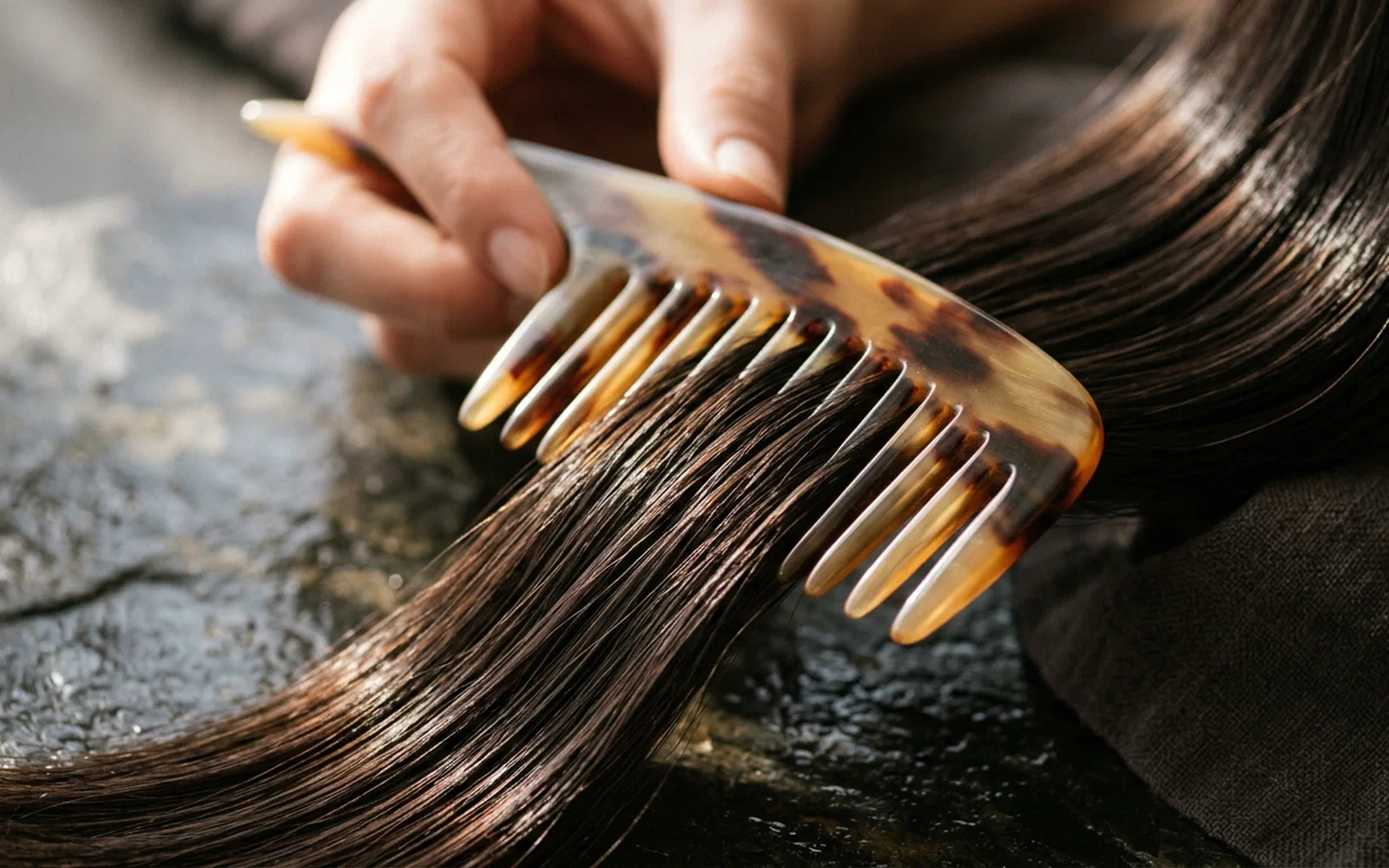
Wet handling. Hair is far more fragile wet than dry, so this is where careless minutes cost the most. If your hair is straight or wavy, let it dry part-way before detangling with a wide-tooth comb from the ends upward. If it is curly or tightly textured, the opposite is safer: detangle in the shower while conditioner is still on.
Can broken hair be repaired?
No, and that is worth saying plainly rather than softening. Hair outside the scalp is not living tissue. Once a strand splits or snaps, nothing rejoins it, and no product on any shelf can.
So the goal moves. Haircare is not rescuing the strand that already broke; it is smoothing the surface of the ones that have not, so the comb passes instead of catching. The unit of progress here is months rather than days, which is exactly why the habit list above matters more than any bottle.
How much hair fall is normal, and when does it stop being a habits question?
Something like 50 to 100 strands a day is the range dermatology bodies including the American Academy of Dermatology describe as ordinary turnover. Wash days look far worse than that because two or three days of already-released hairs leave together, which is arithmetic, not a bad shampoo. If you want to track it, take a photo of your parting in the same spot and the same light once a month; that trend is honest in a way a single morning’s count never is.
Some things are not a habits question at all. See a doctor rather than reaching for another bottle if you notice coin-shaped bare patches, redness, soreness or pustules on the scalp, a parting that is widening quickly, shedding that has stayed heavy past three months, or thinning along a hairline you have been tying tightly for years. Shedding in a child or teenager belongs with a doctor too. A full account of the numbers and the red flags is in how much daily hair shedding is normal.
What changes tonight?
If the strands you are finding have no bulb, six habits carry most of the difference, and all of them are free.
- Wash. Work the shampoo into your scalp and let the lather run down the lengths rather than bunching and scrubbing them together.
- Condition. Every wash, from about ear height down. Skipping it leaves the surface rough, and rough surfaces catch.
- Dry. Press and blot with a towel. Do not rub in circles.
- Detangle. Wide-tooth comb, starting at the ends and working up in sections, easing knots apart with your fingers first.
- Blow-dry. Moderate heat, nozzle 15 to 20 cm away, keep it moving, finish cool.
- Tie. Fabric-covered ties or soft scrunchies, loosely, in a different spot each day.
Conclusion: read the strand first, then decide where the month goes
Hair fall and hair breakage look identical on a bathroom floor and want opposite responses. The root end tells you which you have in about five seconds. A white bulb sends you to a timeline, a photo record and, if it persists, a doctor. A flat break sends you to tonight’s towel, tie and dryer, which is the one you can start reducing today.
Further reading
Salon Authority · Q&A
Common questions
How do I know if it is hair fall or hair breakage?
Are the short fluffy hairs around my parting new growth or broken bits?
Does wearing a tudung cause hair breakage?
Why does my hair snap so easily after rebonding or a keratin treatment?
Can broken or split ends be repaired?
How much hair fall is normal in a day?
When should I see a doctor instead of changing shampoo?
Related reading
 Hair & Scalp Diagnosis
Oily Scalp and Dandruff in Malaysia: What Should You Do?
Oily roots and flakes are not a diagnosis. Learn how to wash according to hair type, use dandruff shampoo as …
 Scalp Care
How Often Should You Wash Your Hair in Malaysia?
There is no universal wash schedule for Malaysia’s heat and humidity. Use scalp oil, sweat, hair type and …
 Scalp Care
Do You Need a Scalp Serum, or Is Shampoo Enough?
Shampoo and scalp serum are different product formats, not steps everyone needs. Learn what rinse-off and …