RENATA SALON GAZETTE · KNOWLEDGE ISSUE
Reading a Label
Tea Tree Oil and a Flaky Scalp: The Part That Holds Up
On this page
The flakes come back the week after you switch shampoos, so you stand in the Watsons aisle and reach for the green bottle, because tea tree is the one ingredient everybody has heard of. It is a reasonable reach. It is also one of the few scalp ingredients on that shelf with a proper randomised trial behind it, which makes it worth reading carefully rather than hopefully.
What tea tree oil actually is
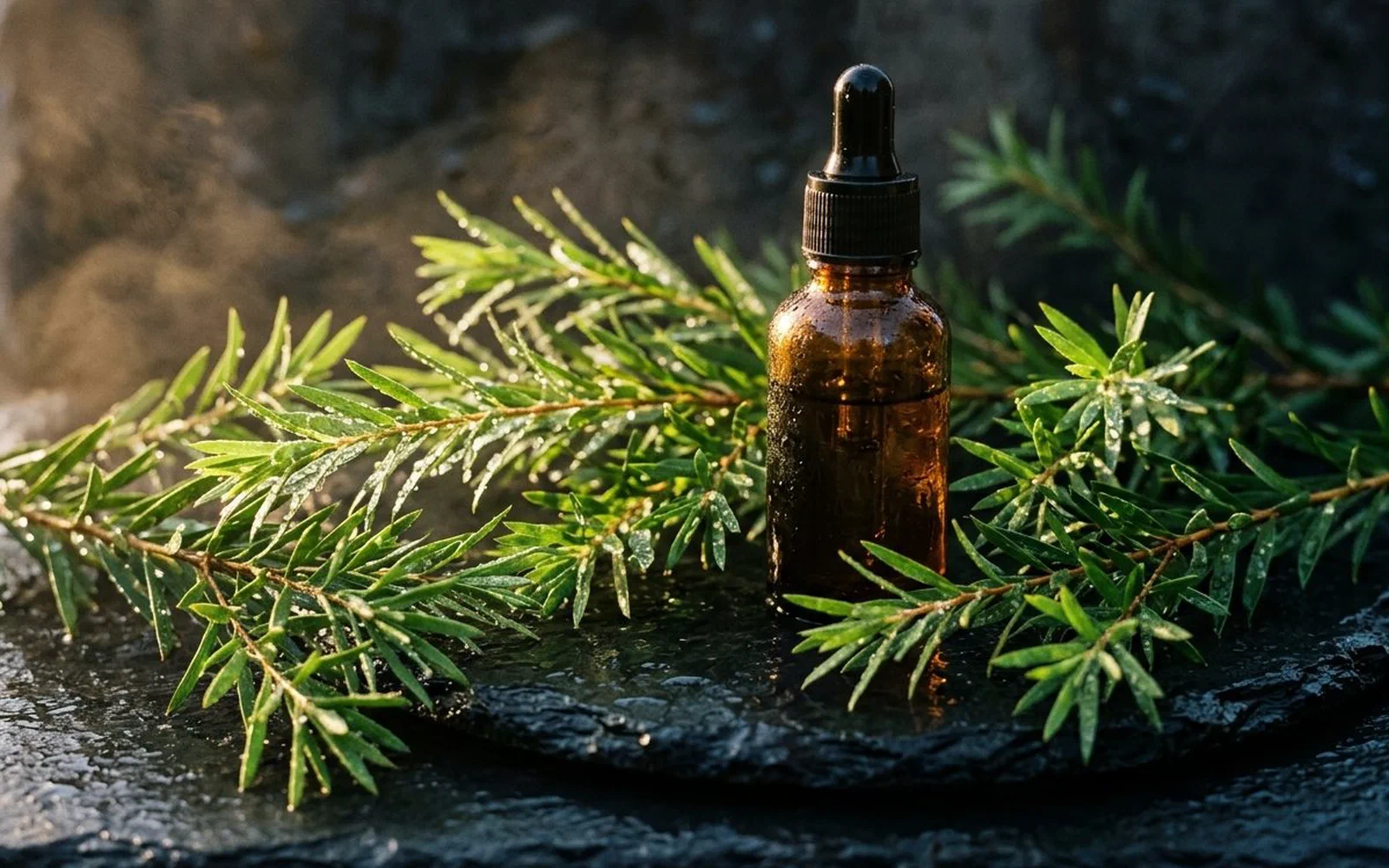
tea tree oil · Melaleuca alternifolia
That specification matters more than it looks. Tea tree oil is a mixture of terpenes, and the proportions move from batch to batch. Two bottles both labelled pure tea tree oil can behave differently on your scalp, and the one carrying more 1,8-cineole is the harsher of the two. Natural is not a synonym for gentle, and tea tree is the ingredient where that shows most plainly.
What the dandruff evidence shows
One trial carries most of the weight, and it is a good one.
In 2002 the Journal of the American Academy of Dermatology published a randomised controlled trial in which 126 people used either a 5% tea tree oil shampoo or a placebo, every day, for four weeks. The tea tree group improved 41% on the quadrant severity score against 11% for placebo, a statistically significant difference, with self-rated itchiness and greasiness improving alongside it (PubMed 12451368). A 2023 systematic review that gathered the human trials together found the direction of the evidence consistent (Frontiers in Pharmacology, 2023).
The safety column belongs in the same paragraph. Of the 63 people in the tea tree arm, three reported mild adverse effects: stinging eyes, a burning scalp, an itchy scalp. So the finding is that a 5% shampoo beats placebo over four weeks. It is not a finding about pure oil, about higher concentrations, or about scalp conditions that need medicine.
Where it sits next to the pharmacy shelf
The useful comparison is not which bottle is stronger. It is which job each one is for.
| Tea tree shampoo | Medicated ketoconazole shampoo | |
|---|---|---|
| What it is | An everyday cosmetic cleanser | A medicine |
| Starting it | No appointment needed | Commonly guided by a doctor, with a labelled frequency |
| Rhythm | Fits an ordinary weekly wash pattern | Limited frequency, per the label |
| Best suited to | Ordinary, responsive flaking | Flaking that has not settled with routine care |
A stubborn scalp that needs medicine-strength help is a doctor’s side of the line. An ordinary flaky week is where the green bottle earns its place. The months spent moving from one brand to the next are the expensive part of this problem, not either bottle.
Reading the oil-control claim honestly
Half of it stands up. People in the 2002 trial did rate themselves as less greasy, so the lighter feeling after washing is real and measured.
What has not been shown is the second half: that tea tree itself makes the scalp produce less oil. No human trial supports that step. The clean feeling comes from the whole formula, the cleansing system and the cooling sensation included.
That distinction earns its keep here. The Malaysian Meteorological Department puts peninsular relative humidity in the 80 to 88% band (MET Malaysia). Between a helmet, the walk to the car and an air-conditioned office, a good deal of what you feel at the roots by mid-afternoon is sweat and humidity sitting on top of oil. Washing that away is a cleansing question, and it responds to cleansing.
Why an old bottle stings
Because it has oxidised. Exposed to air, light and heat, tea tree oil degrades into peroxides and breakdown products including ascaridole. Fresh oil is a weak to moderate sensitiser, and oxidised oil is markedly more sensitising (Contact Dermatitis, de Groot and Schmidt 2016).
Local conditions accelerate this, and most people store the bottle in the worst available place. Keep it in a dark glass bottle, close it properly, keep it out of the bathroom, and finish it within about six months of opening. A bottle that smells sharper than it used to has already changed.
Using it sensibly here
- Stay at shampoo strength. The evidence lives at around 5% in a formulated base. Neat oil on the scalp is where the irritation reports come from.
- Patch test before the scalp. Inner forearm, a small amount, left alone for a day. This matters more with a bottle that has been open a while.
- Keep the eyes out of it. Stinging eyes was among the reported effects. Rinse forward.
- Give it the four weeks. The trial ran four weeks of daily use. Judging a scalp product after three washes tells you very little.
- Watch the storage, not just the shelf life. Heat and light do more damage here than the printed date suggests.
When this stops being a shampoo question
Some signs are not for the aisle. Severe or persistent symptoms, marked redness, pain, weeping, crusting, thick adherent scale, spreading patches, or flaking that comes with unusual shedding all deserve a proper assessment. Dandruff, seborrhoeic dermatitis and other scalp conditions can look alike from the outside, and telling them apart is a clinical job (American Academy of Dermatology).
Note: everyday scalp care supports comfort and cleanliness. If your scalp is inflamed, painful or acutely irritated, a dermatologist should see it first.
Conclusion: tea tree has evidence, and the handling decides the result
A 5% tea tree shampoo has a real randomised trial behind it for ordinary dandruff, and it holds its place as an everyday option you can start on your own. The two things that decide whether your experience matches the trial are concentration and condition: shampoo strength rather than neat oil, and a fresh bottle rather than one that has spent a year above the shower.
If flaking is arriving with an oily, itchy scalp that keeps returning, the pattern is worth reading before the next bottle.
Further reading
Salon Authority · Q&A
Common questions
Does tea tree oil actually work on dandruff?
Can I put undiluted tea tree oil straight on my scalp?
Why does my old bottle sting when it never used to?
Is tea tree the same thing as tea?
Does tea tree oil control oil?
Tea tree shampoo or a pharmacy anti-dandruff shampoo?
Is it safe to use every day in Malaysia's humidity?
Related reading
 Reading a Label
Silicones in Shampoo: Friend, Foe, or Marketing Villain? A Malaysian Guide
What dimethicone actually does to hair, why the follicle-clogging myth doesn't hold up, when silicone helps …
 Reading a Label
The RM-Premium 'Amino Acid' Bottle at Watsons: How to Check It Really Is One
Amino acid is a class of surfactant, not a certification. How to find the surfactant lines on a Malaysian …
 Reading a Label
What is an NPRA NOT Number in Malaysia? How to Verify Haircare & Cosmetics on QUEST3+
Cosmetics sold in Malaysia require notification with NPRA. Learn what a NOT number actually means, what it …