RENATA SALON GAZETTE · KNOWLEDGE ISSUE
Reading a Label
Silicones in Shampoo: Friend, Foe, or Marketing Villain? A Malaysian Guide
On this page
“Silicone-free” sits on a green badge across half the shampoo shelf at Watsons and Guardian, usually a few ringgit above the bottle right next to it. The badge is doing the selling. What it’s selling against does one very ordinary job on hair — worth knowing before the badge decides for you.
What does “silicone-free” actually promise?
Less than the badge implies. It’s a marketing claim about one ingredient category, not a verdict on whether the shampoo is gentler, more natural, or better for your hair. Some heads genuinely do better without silicone. Plenty don’t notice the difference at all, and a few do worse. The only way to know which one you are is to know what the ingredient does in the first place.
Dimethicone · silicone
What does dimethicone actually do to hair?
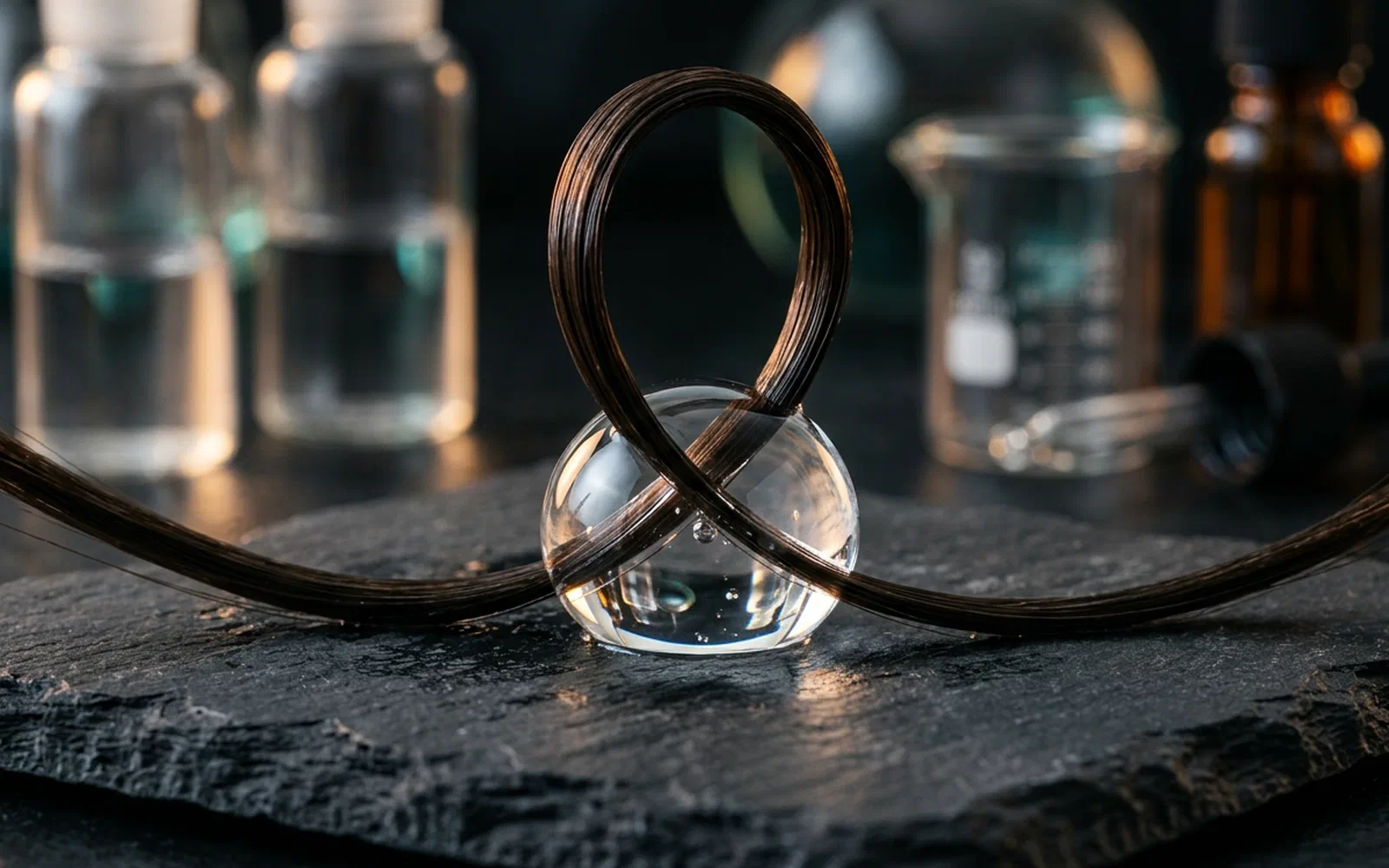
It works as a friction shield. A 2023 review in the Journal of Cutaneous and Aesthetic Surgery puts the mechanism plainly: silicones work “by their film-forming action” to “reduce interfiber friction and give shine, slip, and smoothness to hair,” which is the whole reason they end up in conditioners, serums and even antidandruff shampoos, where the same review notes they’re used “as part of scalp care” without issue. Less friction between strands means less snagging when you comb, less static, and a smoother surface that catches light more evenly — which is what a shine claim on a bottle is actually describing.
Does silicone clog hair follicles or cause hair loss?
No, and the mechanism to make that true doesn’t exist. A hair follicle sits beneath the scalp’s skin, fed by blood supply from below; dimethicone sits on top of the hair shaft that has already grown out and left the follicle behind. There’s no path from a coating on the visible strand back down into a structure under the skin. The same 2023 review describes dimethicone on skin as “hypoallergenic, noncomedogenic” — the technical way of saying it doesn’t block pores, scalp included. What actually irritates a scalp is product sitting unwashed under oil, sweat and heat for too long, which is a washing-frequency question, not a silicone one.
When does silicone earn its place — and when should you skip it?
Think of it as a tool for a specific job, not a default:
- Bleached or balayage hair. Lightened hair has the most cuticle damage there is — that’s exactly the friction dimethicone is built to smooth. This is where it earns its keep hardest.
- Frizz in Malaysia’s humidity. Relative humidity sitting in the 80–88% range for most of the year pushes moisture into the cuticle and lifts it, which reads as frizz. A silicone film slows how fast that happens.
- Fine, oily roots. The same film that smooths damaged lengths can sit heavy at the scalp on fine hair that’s already producing enough oil — this is where “flat by 3pm” usually starts.
- Daily washers with a very mild shampoo. A gentle, low-sulfate formula cleans less aggressively by design, so a non-water-soluble silicone has more chance to sit and build rather than rinse fully each time.
The fix for those last two isn’t giving up silicone altogether — it’s keeping it off the roots, or reaching for a water-soluble version (see the table below), or clarifying every week or two if buildup is already showing.
How do you actually spot silicones on an INCI list?
They’re not hidden — the ending gives them away. Look for -cone (Dimethicone, Amodimethicone), -siloxane (Cyclopentasiloxane) and -conol. Malaysian labels print the INCI name directly in English, so this is the fastest way to check a bottle without needing a translation. Ingredients are listed roughly by how much of the formula they make up, so a silicone sitting near the top of a short list is doing more work than one buried near the preservatives at the bottom.
| Type | INCI name | What it does | Best for |
|---|---|---|---|
| Standard | Dimethicone | The base friction-and-shine film. Doesn’t rinse away easily | Damaged, frizzy lengths that need daily smoothing |
| Volatile | Cyclopentasiloxane | Spreads easily, evaporates off, leaves slip without weight | Fine or oily hair that still wants some smoothing |
| Water-soluble | Dimethicone Copolyol, PEG-12 Dimethicone | Rinses fully with a normal wash — lowest buildup risk | Anyone worried about silicone sitting on the hair too long |
| Cationic | Amodimethicone | Positively charged — seeks out damaged, negatively-charged hair specifically | Colour-treated or chemically processed hair, repair and colour-protect formulas |
Does silicone fade colour on balayage or coloured hair?
No — and this is the part most shelf talk gets backwards. The variable that actually drains colour is the surfactant, specifically sulfates, which is the full story behind why hair colour fades so fast in Malaysia. Silicone isn’t even on that list. If anything, a cationic silicone works in your favour: amodimethicone’s positive charge makes it seek out damaged hair the same way a cationic dye does, which is exactly why colour-protect and colour-enhancing shampoo formulas use it alongside the pigment rather than avoiding it — a colour-enhancing shampoo patent on record (patent US7875085B2, Kao Germany GmbH) describes a cationic silicone conditioning agent formulated together with dye to “enhance colour and shine of hair” in one product. Skipping silicone to “protect” a fresh colour is solving the wrong problem.
The short version
Dimethicone is a coating, not a chemical treatment and not a scalp hazard — it smooths friction on the outside of the hair shaft and nothing more, which is also why the follicle-clogging story never had a mechanism behind it. Reach for it on bleached and balayage hair and on frizz-prone days; go easier at fine, oily roots or pick a water-soluble type; and on coloured hair, spend your attention on the surfactant, not the silicone.
Working out which end of that trade-off your hair sits on usually comes down to your base colour and how far it’s faded — start with the purple shampoo guide if yellowing is the issue, or take the 3-Question Shade Quiz → to see which family your colour needs topping up with.
Salon Authority · Q&A
Common questions
Is silicone-free shampoo better for oily scalps?
Will silicone build up on my hair if I don't use silicone-free shampoo?
Can I use a silicone serum after a silicone-free shampoo?
Is amodimethicone the same thing as dimethicone?
Should I avoid silicone on balayage or bleached hair?
Where can I actually check what silicones are in my shampoo?
Related reading
 Reading a Label
Tea Tree Oil and a Flaky Scalp: The Part That Holds Up
Tea tree oil has one solid randomised trial behind it for everyday dandruff: a 5% shampoo, four weeks, a 41% …
 Reading a Label
The RM-Premium 'Amino Acid' Bottle at Watsons: How to Check It Really Is One
Amino acid is a class of surfactant, not a certification. How to find the surfactant lines on a Malaysian …
 Reading a Label
What is an NPRA NOT Number in Malaysia? How to Verify Haircare & Cosmetics on QUEST3+
Cosmetics sold in Malaysia require notification with NPRA. Learn what a NOT number actually means, what it …