
RENATA SALON GAZETTE · KNOWLEDGE ISSUE
Scalp Care
Why Is My Hair Flat by 3 pm? Fine Hair, Helmet Sweat and the Air-Conditioned Office Day
On this page
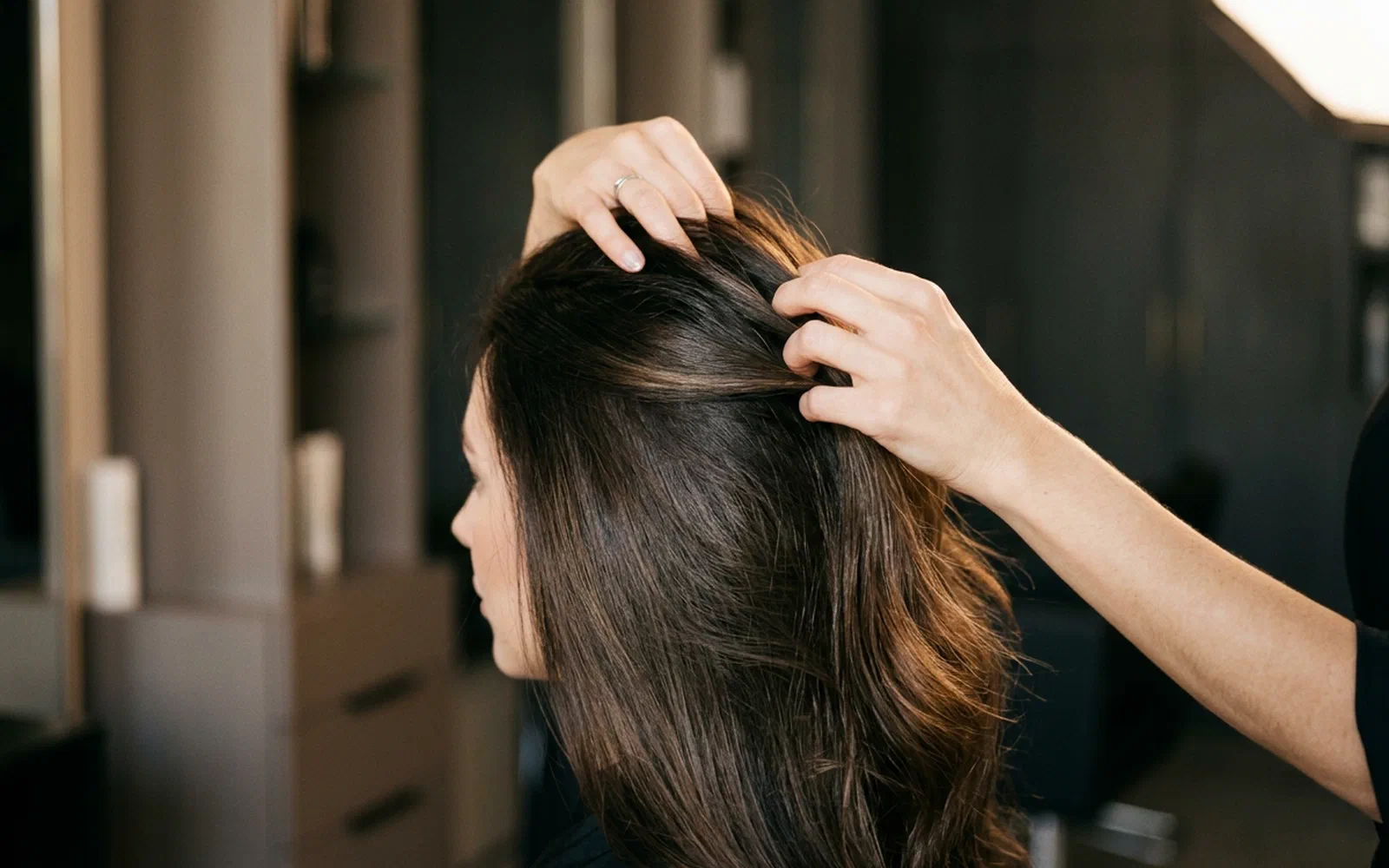
You washed your hair before leaving. By the time you had walked from the car park, or lifted the helmet off, the scalp already felt warm and slightly damp. Two hours into a cool office and the crown has quietly come back down to meet your head, and the parting looks wider in the lift mirror than it did at the bathroom sink.
If you have fine hair in Kuala Lumpur, that is the whole day in one sentence. The cause sits in the first two centimetres above your scalp, and almost all of it is fixable with three habits that cost nothing.
Why is your hair full at 8 am and flat by 3 pm?
Fine hair does not collapse on a schedule for mysterious reasons. It collapses because the roots gain weight across the morning, and light strands have very little structural stiffness to resist it.
Three things load them, in this order:
- The humid commute. Heat, humidity and sweat can leave the roots damp and make strands sit closer together.
- The helmet, cap or tied-back style. Pressure against a damp crown can flatten the roots before they have had a chance to dry with lift.
- The air-conditioned office. Moving between outdoor heat and a cool office changes how the scalp feels, even when the roots still look shiny.
None of that is damage. It is load, and load is a physical problem with physical answers.
Is this fine hair, flat roots, or fewer hairs?
Getting this distinction right is what stops people buying the wrong thing.
Fine hair
- Fine is your hair type. You manage it with lighter habits, not by fixing it.
- Flat is today’s condition. It is caused by weight at the roots and it clears with the next proper wash and dry.
- Fewer hairs is a change in density over weeks and months, which is a different question entirely and covered in how much daily shedding is normal.
Put simply: fine is the texture you were given, flat is the state you are in today. Only the second one answers to technique.
Where does shampoo actually need to go?
On the scalp, worked in with the pads of your fingers. Not scrubbed through the lengths, which is where most people spend their time and where nothing useful happens.
The reasoning is unglamorous. What flattens fine roots is the sebum and styling residue sitting at the root base, and that is a scalp problem. Guidance from the American Academy of Dermatology puts it the same way: concentrate shampoo on the scalp rather than working it through the whole length of the hair, since that is what clears accumulated oil and product without over-drying the mid-lengths (AAD · Tips for healthy hair).
Three details make the difference between washing your hair and washing your scalp:
- Follow the label amount. Spread the cleanser across the scalp rather than repeatedly adding more because the foam looks sparse.
- Finger pads, small circles, hairline to crown. Sparse lather is normal on a clean-ish head and is not a reason to add more product.
- Spend longer rinsing than lathering. This is the step people cut when they are late, and it is the step that decides the afternoon.
How do you know you have rinsed thoroughly?
There is no universal “squeak test”. Hair feel changes with the formula, water and condition of the fibre. Follow the label, rinse until visible foam is gone and the water runs clear, then check the areas where dense hair can slow the rinse.
Dense areas behind the ears and at the nape are easy to rush. Part the hair with your fingers and let the water move through before you finish.
Why does conditioner near the roots cost you the afternoon?
Conditioner smooths the hair fibre and adds slip. On the lengths that reads as shine and easier combing; close to fine roots, a rich formula may take away some visible lift.
Start at ear level and work downwards. Ends first, then rinse thoroughly according to the label.
| Step | Flattens the roots | Lifts the roots |
|---|---|---|
| Shampoo placement | Rubbed through the lengths | Finger pads circling on the scalp |
| Lather | More product when foam looks thin | Same amount, more contact time |
| Rinsing | Stops while foam remains | Continues until visible foam is gone and water runs clear |
| Conditioner placement | Crown to ends | Ear level to ends |
| Leave-on products | Heavy oils near the roots | Water-light textures at the scalp, oils on the ends only |
| Drying order | Ends first, roots left damp | Parting flipped, roots taken to fully dry first |
| Finish | Stops on hot air | Ten seconds of cool air to set |
How do you blow-dry so the lift survives the commute?
This is the one salon habit worth stealing, and it is free.
- Press the water out with a towel rather than rubbing. Wet hair is at its most fragile; rubbing buys you frizz you will fight all day.
- Flip your parting to the opposite side of where it normally falls. Tip your head forward so the air travels through the roots from underneath, and dry the root area until it is completely dry.
- Flip the parting back and take the mid-lengths to the ends smoothly, downwards.
- Finish with cool air if it suits your style. Then return the parting to its usual side.
The useful rule is simpler: comfortable heat, some distance from the scalp, and a hand that keeps moving.
Can a shampoo give you more hair?
No, and this is worth saying plainly rather than leaving in the small print.
No shampoo, serum or styling product adds hairs to your head. A good wash can remove the oil and residue that makes roots sit together, so the hair you already have looks more open and full. That is a temporary styling effect, not a change in density.
Which is the good news, in a way. A same-day physical effect is one you control, tonight, with no purchase involved.
Does anything else in the bathroom matter?
Less than the internet suggests. Kuala Lumpur’s tap water is soft, so mineral build-up is not what is happening to your hair here; the fuller version of that question, including what a shower filter does and does not change, is in tap water, shower chlorine and the high-rise reality.
Wash frequency matters more. Most people with fine hair in this climate find one proper wash a day comfortable, because the roots go down as soon as they take on oil. The number is not the point. Whether each wash actually reaches the scalp is.
Conclusion: clean roots and dry roots are what volume is made of
Fine, flat hair is not a verdict on your hair. It is the result of three things you do on wash day: where the shampoo goes, where the conditioner stops, and how dry the roots are before you touch the lengths. Do all three tonight and the parting in tomorrow’s lift mirror will be narrower than today’s.
Further Reading
Salon Authority · Q&A
Common questions
Why does my hair look full in the morning and flat by 3 pm?
Is fine hair the same thing as thinning hair?
Can a volumising shampoo actually give me more hair?
Can I put conditioner near my roots if I only use a little?
How do I know I have rinsed properly?
Does dry shampoo fix flat roots at 3 pm?
How should I blow-dry fine hair so the lift lasts past lunch?
Related reading
 Scalp Care
How Often Should You Wash Your Hair in Malaysia?
There is no universal wash schedule for Malaysia’s heat and humidity. Use scalp oil, sweat, hair type and …
 Scalp Care
Do You Need a Scalp Serum, or Is Shampoo Enough?
Shampoo and scalp serum are different product formats, not steps everyone needs. Learn what rinse-off and …
 Scalp Care
Plant Vesicles and Exosomes in Haircare: What Do the Terms Mean?
Plant vesicle, nanovesicle and exosome are not interchangeable proof of performance. Learn why researchers …